











In 2026, mobile apps have become core infrastructure, shaping how people work, shop, connect, and entertain themselves. With this reliance, expectations have hardened: reliability, intelligent personalization, and transparent data practices are now baseline requirements for trust. Performance failures no longer register as minor glitches, they trigger immediate churn, lost revenue, and reputational damage.
For enterprises and mobile‑native businesses, app performance is inseparable from brand reputation and customer retention. For engineering leaders, the mandate is practical: design systems that anticipate failure, embed resilience, and deliver adaptive experiences under real‑world conditions. Reliability has shifted from background metric to operational priority, directly tied to retention and growth.
About the Report
This study draws on survey data from 1,000+ U.S. mobile app users, reflecting diverse demographics and usage intensity. The findings reveal how performance failures translate directly into lost customers, wasted acquisition spend, and reputational damage. For engineering leaders, the mandate is clear: embed resilience, observability, and adaptive design into production systems, anticipating issues that surface only under load or on specific devices.
Executive Summary: Stability as the New Growth Engine
In 2026, mobile apps are judged as daily infrastructure, not conveniences. Reliability has become the baseline expectation: 83.4% of users rate stability as “Extremely” or “Very important,” and 15.4% uninstall after a single crash. Failures that don’t reproduce in staging or surface only on specific devices now carry immediate churn risk.
AI adoption is rising in shopping, gaming, and social media, but privacy concerns have surged to 72.4%. Autonomous features introduce new systems risks, where debugging and recovery become harder without transparent telemetry and controls.
Revenue exposure is most visible during peak events: 53.2% of users abandoned purchases during major sales due to crashes or slowdowns. These failures compound lost transactions, wasted acquisition costs, and reputational damage.
Emotional volatility shortens the recovery window. Frustration and productivity loss mean users rarely wait to see if performance improves, they churn immediately.
Key Takeaways for Engineering Leaders
- Stability is retention-critical: A single crash can trigger churn; prevention must move earlier into production systems.
- AI is a control problem: Autonomous behaviors complicate debugging; transparency and traceable telemetry are essential.
- Peak-event resilience is ROI-positive: Failures during sales are compounded revenue loss and wasted acquisition.
- Emotion maps to churn risk: Frustration accelerates abandonment, making incident response speed a measurable priority.
- Reliability is reputational: Performance excellence builds trust; instability erodes it instantly.
User Expectations: No Margin for Error
The Collapse of Tolerance
User patience has narrowed to near zero. Over half uninstall after 2–3 crashes, and 15.4% leave after just one. Performance is rated “Very” or “Extremely important” by 81.3%, showing reliability is no longer a differentiator but the minimum price of entry.

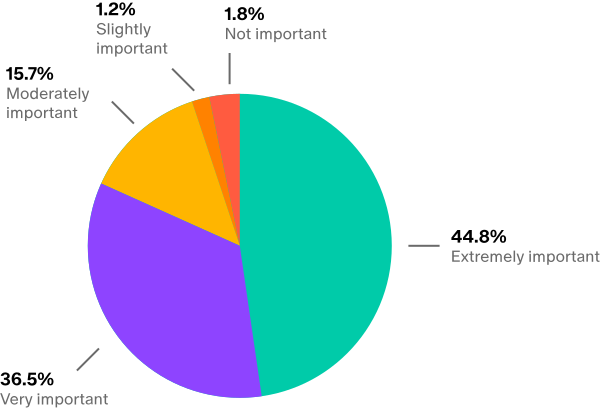
Together, these figures show the margin for error has narrowed to near zero. Reliability is no longer a differentiator but a baseline expectation.

For engineering leaders, this means failures that don’t reproduce in staging or appear only on specific devices must be anticipated in production. Brand equity cannot shield apps from technical breakdowns; stability has become the baseline requirement for retention.
Outstanding Performance: The Hidden Benchmark of Brand Equity
77.5% of users say repeated poor performance damages brand perception, while 83.5% report that outstanding performance improves it. Reliability now shapes brand equity directly: excellence builds trust, failure erodes it instantly.

At the same time, positive experiences directly enhance reputation: 83.5% report that outstanding app performance improves their perception of a company.

For engineering leaders, performance is no longer invisible infrastructure. Speed, responsiveness, and seamless experience are reputational assets, requiring observability that captures issues under load and across fragmented device environments.
The Performance Economy Reliability as Revenue
Uninstall Thresholds
Crashes and slow performance are equally intolerable for most users, with 44.9% citing both as equally frustrating. Every failure is a potential churn event, making reliability a non‑negotiable baseline.

Every crash or slowdown is a potential churn event. The margin for error has narrowed to near zero. For engineering leaders, this means designing for scenarios where rollback is costly and visibility limited, especially under peak traffic.
Reliability as a Monetizable Differentiator: Baseline vs. Premium Expectation
29.1% of users have chosen paid tiers for better performance, and nearly half would pay more for guaranteed stability. Yet most expect reliability at no extra cost.

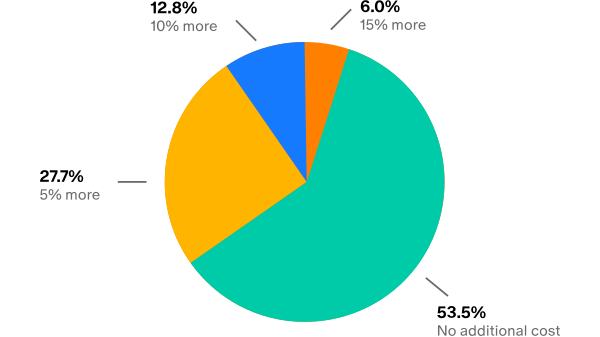

The segmentation is stark. For some, reliability is worth a premium; for most, it is table stakes. For engineering leaders, monetization must be precise: premium tiers for reliability‑sensitive users, baseline guarantees for the majority. Reliability is both a safeguard and a growth lever, but its monetization depends on targeting
Peak‑Event Failures
53.2% of users abandoned purchases during major sales due to crashes or slowdowns. These failures compound lost transactions, wasted acquisition costs, and reputational damage.

Every crash during a peak event is not just a lost transaction but a lost customer and wasted acquisition cost. For engineering leaders, resilience under peak load is the highest‑ROI investment. Failures during sales are not isolated bugs: they are compounded revenue loss and churn.
The Emotional Toll and Switch Threshold
Emotional Dimension of Crashes
63.9% of users admit to cursing or yelling at apps, confirming frustration is normalized. Failures are not neutral glitches but emotional triggers that accelerate abandonment.

Failures are no longer seen as isolated glitches but recurring irritants that shape daily behavior. Younger cohorts are the most volatile, underscoring that technical issues are not neutral events but emotional triggers that erode goodwill. For brands, every crash risks not only session abandonment but reputational damage rooted in emotional volatility. For engineering leaders, this shortens the recovery window: users don’t wait to see if performance improves, they churn immediately.
Lingering Stress and Mood‑Loyalty
Poor performance disrupts plans (57.7%) and productivity (47%), with 11.6% reporting stress that ruins their day. Instability affects both personal and professional spheres.


Crashes and poor performance are no longer just technical failures; they are emotional events that erode “mood‑loyalty,” the fragile bond between user sentiment and brand trust. Apps are judged not only on their utility but on their ability to preserve emotional equilibrium. For engineering leaders, emotional volatility translates into measurable churn risk. Incident response speed becomes as critical as uptime.
Irreversibility of Churn
30% of users are “Very Likely” to permanently switch after failures, and more than half are “Somewhat Likely.” Recovery is rare once trust breaks.


Repeated poor performance damages brand perception for 77.5% of users, as noted earlier. Once trust erodes, churn accelerates, and brand reputation and loyalty become inseparable, once broken, recovery is rare.
For engineering leaders, this means loyalty cannot be assumed. Visible fixes, updates, and differentiated features are required to buffer against churn.
Loyalty Drivers Despite Bugs
Users remain loyal when apps deliver regular updates (57%), unique features (53%), or strong support (42%). Emotional attachment plays a smaller role; loyalty is pragmatic, earned through responsiveness and differentiation.

Emotional attachment to the brand (25%) plays a smaller role, suggesting that loyalty is pragmatic, not sentimental. For engineering leaders, this underscores that reputation recovery depends on visible action, not sentiment alone.
The Strategic Takeaway: Reliability, Emotion, and the Future of App Leadership
Reliability has hardened into the defining growth lever of mobile success. What began as a technical metric has become a reputational asset, a monetizable differentiator for select segments, and the single most important safeguard against churn. User patience has collapsed: uninstall thresholds are lower than ever, performance is judged as a baseline expectation, and failures during peak events translate directly into lost revenue.
At the same time, the emotional dimension of instability is undeniable. Crashes and slowdowns provoke frustration, stress, and productivity loss, eroding “mood‑loyalty” and accelerating irreversible churn. Once trust breaks, recovery is rare, and loyalty is pragmatic, earned through updates, unique features, and responsive support rather than sentiment alone.
The strategic lesson is clear: prevention is cheaper than reacquisition. Outstanding app performance has shifted from invisible infrastructure to a visible attribute of brand equity, while emotional stability has emerged as a competitive advantage. In this environment, mobile leaders must treat reliability not as background engineering, but as the cornerstone of growth, reputation, and user trust. Doing so requires more than patching bugs: it demands new approaches to observability, iteration, and resilience at scale. The organizations that master these capabilities will define the next era of mobile leadership.
The Rise of AI and the Trust Gap
Adoption Trends
AI features are influencing app choice for 39.3% of users, especially in shopping, gaming, and social media.


Shopping (47.2%), games (41.5%), and social media (39.7%) lead the categories where users want AI improvements, reflecting a desire for personalization and convenience in domains where speed and relevance matter most.
Adoption is pragmatic: users embrace AI where it delivers clear utility, not novelty. For engineering leaders, this means AI demand is concentrated in domains where personalization and speed matter most, but adoption depends on reliability under real-world conditions.
Privacy and Control Concerns
Privacy skepticism has surged: 72.4% cite security as their top concern, and 63.4% fear loss of control over data use. Enthusiasm for AI collides with distrust of the telemetry required to power it.
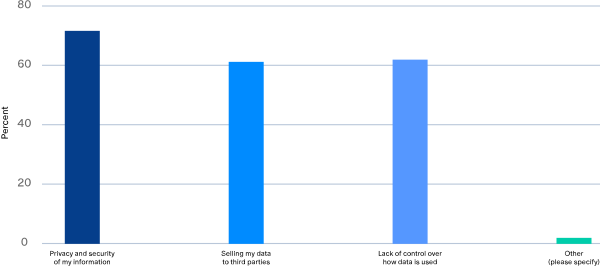
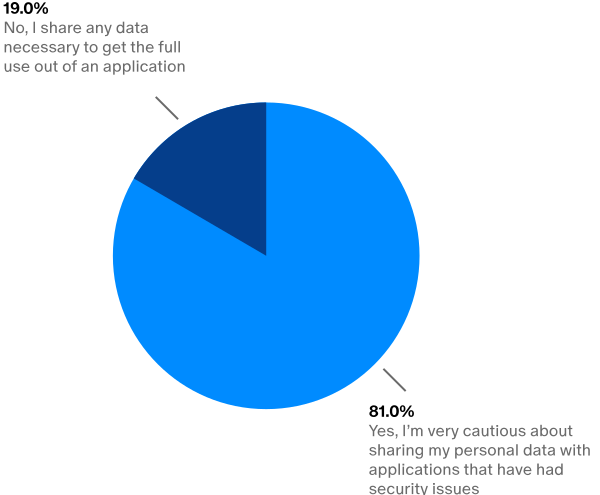
The paradox is clear: users want AI‑driven convenience but demand transparency and control as the price of entry. Without trust, adoption stalls.
Design Trust Fragility
Only 16.6% of users are “Very Likely” to trust AI‑optimized layouts, while a third remain neutral. Trust is conditional, earned through clarity and demonstrable benefit.

Design trust can be earned, but only through transparency and demonstrable benefit. Without clarity, AI risks becoming a liability rather than a differentiator. For engineering leaders, autonomous design introduces risk: cause‑and‑effect becomes harder to trace, making debugging and recovery more complex.
Transparency as Differentiator
63.9% of users say they would be more loyal to apps that clearly explain why data is collected. Transparency consistently converts skepticism into confidence.
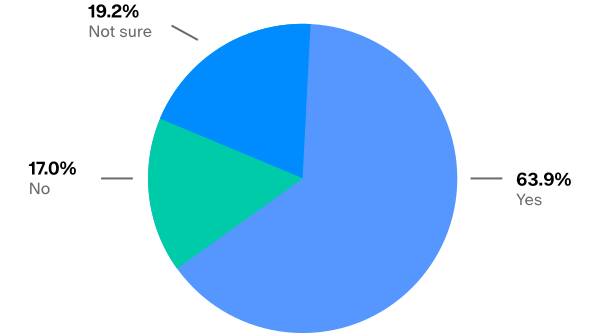
For engineering leaders, this means telemetry and logging must link data collection directly to user benefit. Without this clarity, AI risks becoming a liability rather than a differentiator.
The Strategic Takeaway: Adaptive Apps Demand Adaptive Tooling
AI adoption is rising, but trust has become the defining constraint. Users embrace AI where it delivers clear utility, yet escalating privacy concerns and fragile design trust reveal that convenience alone is not enough. Transparency is the decisive differentiator: it converts neutrality into loyalty and skepticism into confidence. For mobile leaders, the strategic takeaway is blunt: AI succeeds only when it is trusted, and trust is earned through clarity, control, and demonstrable value.
At the same time, anticipation of AI’s deeper integration into apps signals a structural evolution. The nature of apps will likely shift from fixed logic‑tree models into adaptive, agentic systems capable of personalization, prediction, and continuous learning. This transition reframes apps not as static utilities but as dynamic partners: intelligent, responsive, and trust‑dependent.
With this evolution comes a parallel challenge: the tools used to design, scale, manage, and iterate apps must evolve as well. Traditional development frameworks optimized for static workflows will no longer suffice. App creators will need platforms that support continuous learning loops, real‑time personalization, and transparent governance. In other words, the next generation of apps demands a next generation of tooling: systems architected for adaptive intelligence, capable of scaling agentic behaviors while preserving trust. This is where forward‑looking agentic mobile observability platforms become indispensable: enabling teams to build, monitor, and iterate dynamic apps with the same rigor and confidence once reserved for static systems.
Demographic Breakdown: Generational and Gender Gap
The 2026 dataset underscores that mobile behavior is not monolithic; expectations and reactions vary sharply across age and gender lines. Usage patterns reveal that the apps people rely on most are tightly linked to their tolerance thresholds, loyalty drivers, and AI adoption preferences.
Gen Z (18 - 24): The Volatile Digital Natives
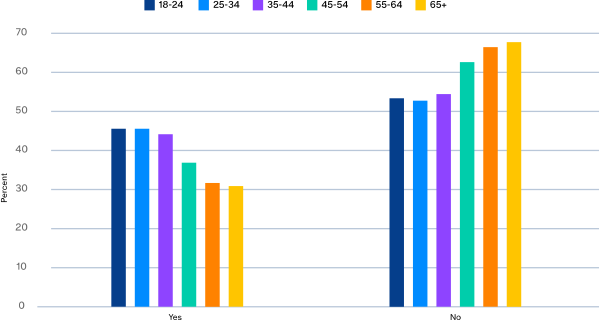
Gen Z represents both the highest risk of churn and the most polarized patience profile. Nearly one‑third abandon apps within five seconds of delay, yet another third tolerate waits of more than ten seconds, and 7.4% refuse to switch at all. Emotional volatility compounds the risk: 74.6% admit to cursing or yelling at an app, making failures reputational events as much as technical ones.
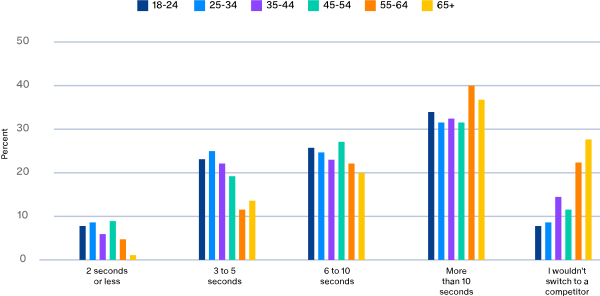

Gen Z’s app usage ranks are led by Entertainment/Streaming (first) and Communication/Messaging (second): a hierarchy that mirrors overall population trends.
However, their tolerance profile diverges in meaningful ways. Gen Z shows the lowest patience for failures in social media, followed by games and shopping, all domains where instant gratification is expected. This contrasts with broader user trends, where shopping apps typically rank as the category with the least tolerance for instability.


At the same time, they show the highest demand for AI integration in shopping (51.6%) and social media (45.9%), underscoring their appetite for personalization.

For Gen Z, success requires a dual strategy: flawless speed in social and entertainment apps, and differentiated AI‑driven innovation to secure the loyal minority.
Millennials (25 - 44): The Productivity Power Users
For Millennials, poor performance is not just an annoyance, it directly undermines professional output and commerce. Among 25–34s, 66.2% report productivity loss due to lag, while 60.7% of 35–44s report the same, the highest of any age group.

Millennials are also the demographic most likely to abandon purchases during peak sales, with 67.2% of 25–34s and 70.2% of 35–44s reporting cart abandonment due to crashes.
.svg)
25–34s are the only group to rank communication/messaging as their #1 category, pushing entertainment to #2, while 35–44s elevate productivity apps into their top three, displacing health & fitness.

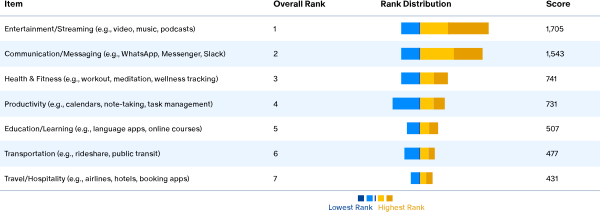
The 25-34 cohort express lowest tolerance for failures in social media (#1) and shopping (#2). Notably, for the 35-44 cohort, finance apps emerge as their #1 most critical category, linking instability directly to financial risk.

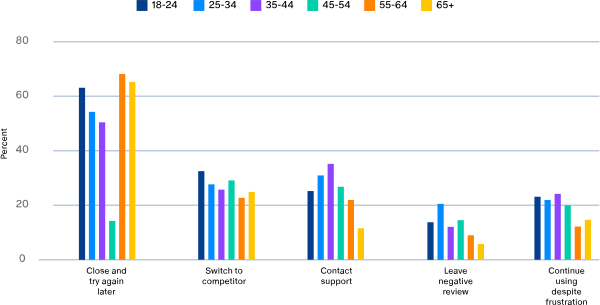
This cohort balances impatience with pragmatism, often contacting support, rather than immediately switching. Reliability here is not just about satisfaction: it is about safeguarding workplace efficiency and transactional trust.
Gen X (45 - 54): Steady but Demanding
For 45–54s, stability and performance are paramount, with 57.4% rating stability “extremely important” and 53.4% rating performance the same.


Gen X tolerance is moderate: 56.8% churn quickly, but 32% tolerate longer delays, and 11% refuse to switch.

Interestingly, this group shows the highest interest in shopping AI (54%) of any demographic, suggesting openness to innovation in commerce despite their steadier tolerance. Failures here risk reputational damage, but timely fixes can preserve loyalty.

Boomers (55–64, 65+): The Loyal Skeptics
Boomers are the most tolerant of delays, with only 14–15% abandoning apps within five seconds and over 40% tolerating waits beyond ten seconds.

Their most common response to failure is to “close and try again later” (66.4%), reflecting patience rather than impulsivity.
Boomer app usage is consistent: entertainment and communication dominate, but productivity apps rise to #3, showing reliance on digital tools for organization and communication.

For the 55–64 cohort, lowest tolerance is for failures in shopping (#1) followed by fiance (#2) apps, while for the 65+ cohort lowest tolerance is for failures in finance apps (#1). Boomers are notably more forgiving of social media issues.

AI demand is distinctive: Boomers rank health & wellness (41.8%) as their second most desired category for AI features, nearly tying with shopping. However, Boomer loyalty is conditional: 80.2% cite privacy and security of information as their top concern with AI (within the 65+ cohort).


For Boomers, patience buys time, but transparency is the only safeguard against permanent churn.
The Gender Gap: Monetization vs. Engagement
Gender differences reveal divergent loyalty drivers and usage patterns. Both men and women rank entertainment and communication as their top two categories, but women use transportation apps more frequently (rank #5) compared to men (rank #7), while men use education/learning apps more frequently (rank #5) compared to women (rank #6).

Critical tolerance diverges: men are least forgiving of finance app failures (#1), followed by shopping, while women are least forgiving of shopping failures (#1), followed by finance.
.svg)
AI demand also splits: men show significantly higher interest in AI for finance apps (40.5% vs. 26.5%), while women lead slightly in shopping AI (48.1% vs. 46%).

Behaviorally, men are more likely to solve performance problems with their wallets, with 33.4% choosing paid tiers for reliability compared to 25.4% of women.

Women place higher value on regular updates and unique features, with 57.0% citing updates and fixes as their top loyalty driver compared to 53.4% who highlight unique features not available elsewhere.

This divergence suggests monetization strategies resonate more with men, while feature differentiation, update cadence, and frictionless transactions are stronger retention levers for women.
The Strategic Takeaway: Segmentation as a Leadership Imperative
Taken together, these demographic insights highlight the need for segmented strategies. A one‑size‑fits‑all approach to performance and AI adoption will fail to capture the nuances of user expectations. For mobile leaders, the mandate is clear: success requires tailoring reliability investments, product design, and messaging to the patience, priorities, and trust thresholds of each demographic.
Generational volatility, productivity risk, and gendered loyalty drivers all point to the same conclusion: adaptive platforms and transparent AI are no longer optional: they are strategic levers of growth. Mobile leaders who embed observability, personalization, and resilience into their ecosystems will not only reduce churn but also convert demographic diversity into a durable competitive advantage.
The Leadership Mandate: Reliability, Transparency, Segmentation
The 2026 findings converge on a single mandate: mobile leaders must elevate reliability, transparency, and segmentation from background considerations to core strategic levers. These are no longer optional attributes; they define growth, loyalty, and brand equity in the agentic era.
Operationalize Proactive Resolution
- Monitoring alone is insufficient in a zero‑tolerance environment. Users expect apps to act as partners that anticipate and resolve issues before they occur. Autonomous triage systems, capable of detecting, isolating, and initiating fixes without human intervention, are now essential. They are the only viable defense against the irreversible churn triggered by crashes.
Establish Data‑Utility Clarity
- AI adoption is rising, but privacy concerns have intensified. In 2025, 52% cited privacy/security as their top concern; in 2026, that number surged to 72.4%. This skepticism threatens to undermine AI’s potential unless mobile teams explicitly link data collection to user benefit. Transparency must be reframed as a design principle: “We use diagnostic data to prevent the crashes that interrupt your shopping.” Such clarity transforms suspicion into loyalty.
Monetize Through Tiered Stability
- 29.1% upgraded to paid tiers for reliability, and 46.5% would pay more if zero crashes were guaranteed. This willingness to spend reframes stability as a monetizable differentiator for select segments. Just as broadband providers marketed speed tiers, mobile teams can position reliability guarantees as premium features. However, the majority view stability as table stakes, meaning monetization strategies must be carefully segmented.
Prioritize Peak‑Event Optimization
- The fact that 53.2% abandoned purchases during major sales due to technical failure underscores the disproportionate impact of instability during high‑traffic moments. Retail apps, in particular, must treat peak‑load resilience as the highest ROI investment. Every crash during a sale is not just a lost transaction, it is a lost customer, a damaged brand, and a squandered acquisition cost.