










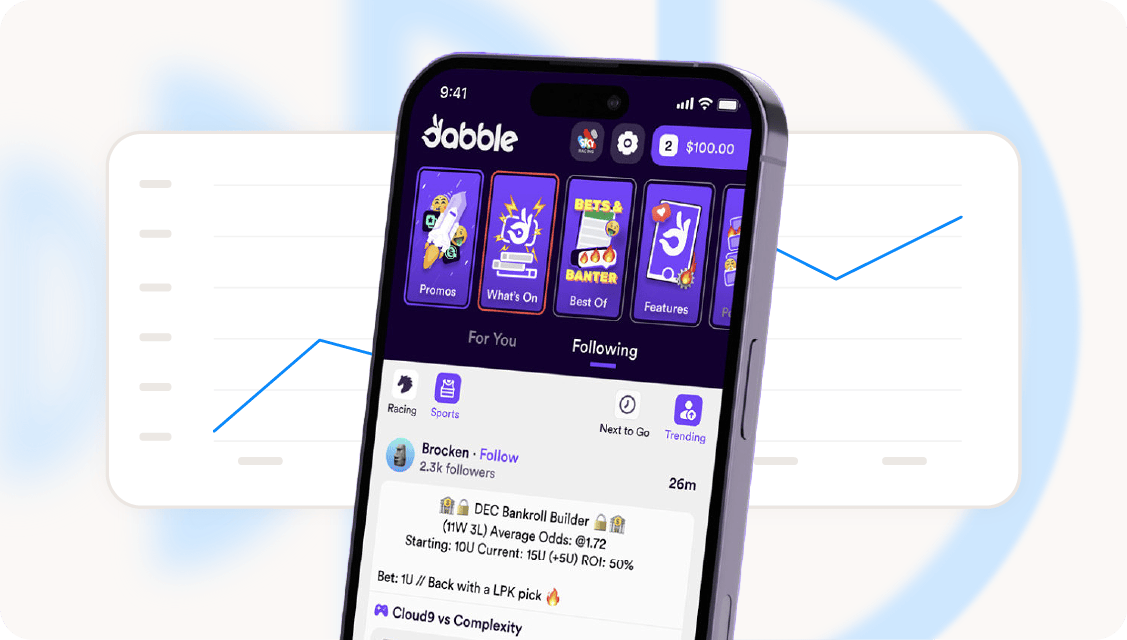
When your mobile app drives the majority of revenue, observability becomes a business system, not just a debugging tool.
For Dabble, every major sporting event generates peak traffic equivalent to Black Friday. A single hour of instability can cost over $1M in lost transactions.
Without complete mobile app observability, peak events become revenue risk events.
The Mobile App Observability Challenge: Sampling, Blind Spots, and High MTTR
Before implementing Luciq, Dabble relied on traditional monitoring and APM tools that required heavy sampling due to cost constraints. Only 5 - 10% of user sessions were visible.
“We just hoped everything would work... we didn't have instant observability and couldn't trust any alerting,” recalled Tommy McIntosh, Staff Platform Engineer at Dabble.
That meant:
- Incomplete mobile user journey visibility
- Limited mobile app crash analytics
- No full-session diagnostics
- High Mean Time to Resolution (MTTR)
Traditional mobile application performance monitoring tools alerted engineers to crashes, but lacked:
- Client-side network correlation
- Full mobile user journey monitoring
- Context-rich reproduction data
- Executive-ready mobile app performance metrics
The result was reactive debugging and extended triage cycles.
Engineers were spending up to 20 hours per week manually digging through logs and attempting to reproduce issues across fragmented devices.
This wasn’t a crash problem. It was an observability and workflow problem.
Implementing Mobile App Observability With 100% Session Coverage
Dabble deployed Luciq’s Agentic Mobile Observability platform to eliminate sampling blind spots and unify crash analytics, performance monitoring, and session replay.
100% Mobile App Crash Analytics and Session Visibility
Instead of partial session sampling, Dabble now captures:
- Every crash event
- Every high-value transaction flow
- Every mobile user session
- Every release
This upgrade to Luciq’s full mobile app observability platform dramatically reduced regression risk during peak wagering periods.
Luciq’s full-session replay and contextual diagnostics accelerated root cause analysis and reduced MTTR by 50 - 60%.
Mobile Application Performance Monitoring With Network-to-UI Correlation
Mobile performance issues often originate outside the app itself.
Payments providers.
Geofencing vendors.
External APIs.
Luciq’s mobile application performance monitoring enables Dabble to correlate:
- Client-side network latency
- API degradation
- UI hangs and slow rendering
- Device-specific runtime conditions
This level of mobile app management visibility allows Dabble to:
- Identify vendor-related slowdowns immediately
- Protect transaction success rates
- Reduce incident cost
- Improve mobile app retention during high-traffic events
Instead of guessing, they have defensible proof.
Improving Mobile App Performance Metrics Across Stability and Velocity
With complete mobile app observability in place, Dabble improved key mobile app performance metrics that directly impact revenue.
50 - 60% Reduction in MTTR
Mean Time to Resolution dropped from days to minutes.
Engineers now receive:
- Automated issue grouping
- Full session replay
- Device and runtime context
- Network trace visibility
- Reproduction flow tracking
“Luciq gives us a real-time safety net; we’re detecting and patching issues in under 30 minutes, often before our users or even our backend systems realize something is wrong," McIntosh said.
This dramatically reduced regression risk during peak events.
20+ Engineering Hours Reclaimed Weekly
By leveraging Luciq to eliminate manual triage and repetitive debugging, Dabble reclaimed more than 20 engineering hours per week per lead engineer.
This improved:
- Mobile app quality assurance workflows
- Engineering productivity
- Release readiness
- Team throughput
Junior engineers now independently own issue resolution, reducing escalation bottlenecks.
Release Management for Mobile Apps: Doubling Shipping Velocity
Before Luciq, Dabble shipped monthly releases.
With Luciq’s mobile app observability integrated into their release management workflow, they transitioned to bi-weekly releases.
Luciq enables:
- Real-time monitoring of new features
- Release-specific performance tracking
- Feature flag monitoring
- Immediate rollback capability
This strengthened release management for mobile apps by reducing regression exposure during phased rollouts.
Release confidence increased. Maintenance overhead decreased.
Maintaining 99.99% Crash-Free Sessions and Protecting Mobile App Retention
During peak sporting events, Dabble maintains a 99.99% crash-free rate.
In mobile-driven industries, stability directly affects:
- User churn
- App store ratings
- Mobile app retention
- Customer lifetime value
Mobile app performance metrics are no longer isolated technical KPIs.
They are retention and revenue drivers.
By leveraging Luciq’s crash analytics, mobile user journey monitoring, and real-time performance diagnostics, Dabble protects both short-term revenue and long-term loyalty.
Advancing Toward Agentic Mobile App Observability
With Luciq’s Agentic Mobile Observability, Dabble leverages intelligent automation to further reduce debugging overhead and operational risk.
Agentic Mobile Observability introduces:
- AI-assisted anomaly detection
- Suggested fixes
- Automated triage workflows
- Reduced manual debugging toil
“Engineers aren’t going to hand over all their code to AI, but we see it as augmentation. If an agent can handle trivial fixes and flag anomalies, it allows us to reach further and do more,” said McIntosh.
This evolution moves mobile app management from reactive maintenance to proactive system optimization.
Why Mobile App Observability Is Now a Competitive Advantage
For mobile engineering leaders, the core tension is clear: ship faster without sacrificing reliability.
Luciq’s mobile app observability platform enabled Dabble to eliminate that tradeoff through:
- Full mobile app observability
- Integrated mobile application performance monitoring
- Actionable mobile app performance metrics
- Embedded crash analytics
- Release-aware monitoring
- Reduced MTTR
The outcome:
- 50 - 60% faster issue resolution
- 20+ hours reclaimed weekly
- Bi-weekly release cadence
- 99.99% crash-free peak sessions
- $1M+ revenue protected during peak events
Mobile app observability is no longer optional infrastructure. It is a revenue protection architecture.
FAQs: Mobile App Observability and Performance Monitoring
What is mobile app observability?
Mobile app observability is the ability to monitor, diagnose, and resolve issues across the entire mobile user journey using full-session visibility, crash analytics, and performance monitoring data.
How is mobile application performance monitoring different from traditional APM?
Mobile application performance monitoring focuses specifically on client-side behavior — including device fragmentation, UI hangs, network latency, and user interactions — which traditional backend APM tools often miss.
Why are mobile app performance metrics important for revenue?
Mobile app performance metrics such as crash-free rate, MTTR, release stability, and user journey completion directly influence retention, transaction volume, and brand trust.
How does mobile app observability improve release management?
By integrating observability into release workflows, teams can monitor feature rollouts in real time, detect regressions early, and roll back faulty deployments before widespread user impact occurs.