







How often should you update your mobile app? Most top apps ship at least once a month, and many ship every week. According to 42matters' 2026 tracking of the top 1,000 apps on each store, 78% of top App Store apps and 74% of top Google Play apps update at least monthly, while 46% and 38% respectively update at least weekly.
The right cadence for your app depends on how it makes money, what category it belongs to and how much your team can ship safely. This guide covers why updates matter, what the data says about free apps, paid apps and different categories, and how to keep a fast release schedule from putting your rating at risk.
Why App Updates Matter
Updates are how you fix what users run into and ship what they ask for. They also shape loyalty: in Luciq's No Margin for Error report, regular updates and fixes were the top reason users stay loyal to an app, cited by 57%.
Updates affect your rating, too. Google Play weights its displayed rating toward recent ratings, so improvements in new versions show up faster. On the App Store, developers can choose to reset their summary rating when they release a new version. On both stores, a strong recent release does more for your rating than an old one.
Automatic updates on iOS and Android also mean users can get new versions without doing anything, so a regular release schedule rarely feels like a burden to them.
Types of App Updates
Not every update is the same. Most apps follow a version number convention with three parts:
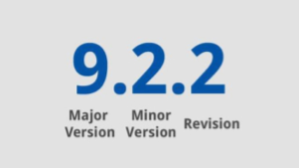
- Major updates: big redesigns or significant new features.
- Minor updates: smaller features and improvements.
- Patches: fixes and performance improvements.
Some apps, like Pandora, use their own variation, but the idea is the same.

Patches ship most often, minor updates less often, and major updates least of all. When teams talk about update frequency, they usually mean the steady rhythm of minor updates and patches.
How Often Do Top Apps Update in 2026?
42matters tracks how often the top 1,000 apps on each store release updates. As of 2026:
- Apple App Store: 46% update at least weekly, 78% at least monthly, and 98% at least once a year.
- Google Play: 38% update at least weekly, 74% at least monthly, and 96% at least once a year.
A monthly cadence is now the baseline for a competitive app, and nearly half of top iOS apps ship every week. Monday is the most popular day to release on both stores.
How Often Should Free and Paid Apps Update?
The 2026 data shows how often apps update overall. To see how the business model changes the picture, Luciq analyzed the version history of the top 100 free, paid and grossing App Store apps in August 2019. The exact numbers have shifted since then, but the patterns still hold.
Free Apps
Top free apps updated about every week: the median time between updates was 8.75 days, and the most common gap was 7 days.
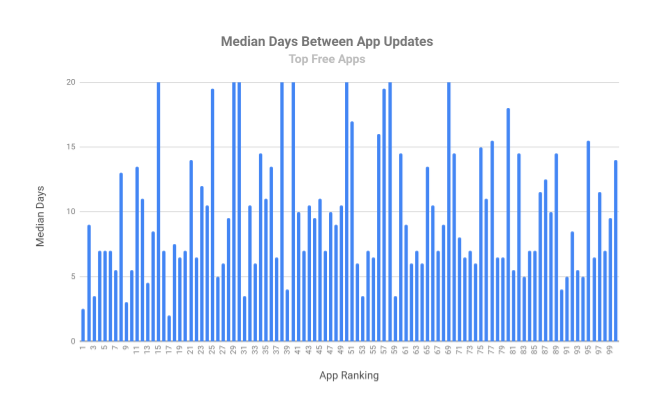
Top grossing apps, which are almost all free to download, updated roughly every two weeks, with a median of 13.5 days and 14 days as the most common gap. Newer free apps tend to ship constantly to build engagement, while established top earners can rely on fewer, larger releases.

Paid Apps
Top paid apps updated far less often. Once outliers were removed, the median gap between updates was 53 days, which points to a monthly or every-other-month schedule.
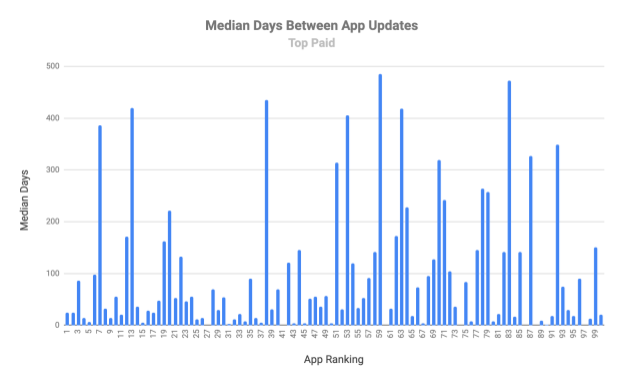
Paid apps collect revenue up front, so they depend less on constant engagement than free apps that earn through in-app purchases or ads. A longer gap between releases raises the stakes for each one, though: if a release goes wrong, users wait longer for the fix.
Update Frequency by App Category
Category matters too. In the same 2019 analysis of the top 10 apps in each category:
- Entertainment apps: a median of 7 days between updates, favoring a weekly schedule.
- Photo and video apps: a median of 8 days, also leaning weekly.
- Music apps: a median of 14 days, favoring a biweekly schedule.
Among paid apps, games and photo and video apps updated closest to the overall average, while music and education apps updated less often, which may reflect products that are less driven by new features.
Use your category as a reference point, not a rule. What matters most is a cadence your team can keep up while keeping quality high.
Does Updating More Often Improve Your App Ranking?
In the 2019 analysis, higher-ranking apps tended to update more often across the free, paid and grossing charts. The trend was consistent: the longer the gap between updates, the lower an app tended to rank.
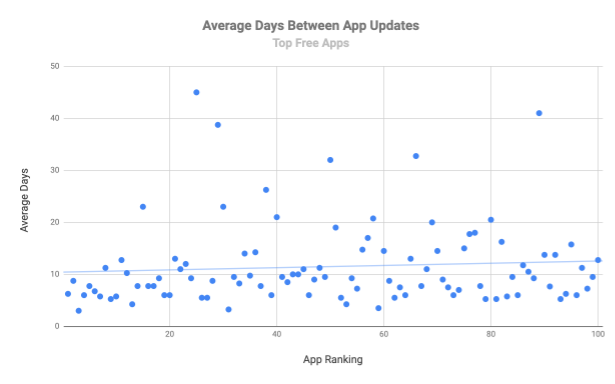
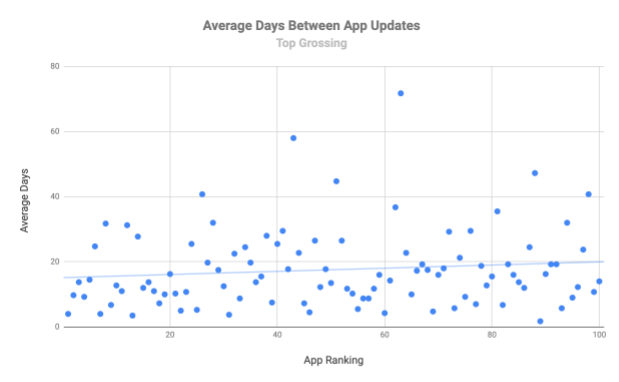
That's a correlation, not proof that updates alone lift rankings. Successful apps have the resources to ship often, and shipping often helps them respond to users faster. What clearly affects your standing is quality. Luciq's 2026 Mobile App Performance Playbook found that apps rated above 4.5 stars cluster near a 99.95% crash-free session rate, and ratings drive conversion on both stores. Our app store optimization guide explains how ratings feed discovery.
Why More Releases Mean More Risk
Shipping more often has never been easier. Coding agents and modern CI/CD for mobile let teams build and ship features in days. But every release puts new code in production, and on mobile, a bad release can't be rolled back instantly. The faster you ship, the more surface area there is for something to break, and the more each release depends on catching problems early.
Even top apps release problems into production. In the 2019 analysis, the most common shortest gap between two releases was just 3 days: the quick follow-up fix after something went wrong.

Platform changes add another layer of risk. Luciq's Playbook shows how the iOS 26 rollout made cold launches and forced restarts spike, disproportionately on iPhone 17 devices, leading to ratings dips and more support requests. Teams that caught it early isolated the issue by device and OS, mitigated it with feature flags and slowed their rollouts until it was fixed. Read more about how OS updates are changing mobile development.
Best Practices for Your App Update Schedule
- Pick a cadence your team can sustain. Weekly or every two weeks suits most free apps, while paid and utility apps can ship less often. Consistency matters more than speed.
- Gate every release on quality. Luciq's Playbook suggests treating about 99.7% crash-free sessions as the floor for a 3-star rating and 99.85% as the bar for 4.5 stars and above. Here's how to improve your crash-free session rate.
- Roll out gradually. Use phased releases, canary releases and feature flags, so a problem reaches a small share of users first.
- Watch every release closely. Track crashes, ANRs, slow launches and reviews by version in the first hours after launch, so you can pause or fix fast. Our mobile app release management guide covers what to watch.
- Listen to users between releases. In-app feedback and reviews tell you what to fix and what to build next.
- Plan major and minor updates around your cadence. Keep big launches off your regular schedule and ship them when they're ready. See our mobile release best practices.
- Prepare for OS releases. Test against beta versions of iOS and Android before they reach your users.
How Luciq Helps You Ship Updates With Confidence
Coding agents have made shipping the easy part. The hard part is knowing what each release actually did to real users, fast enough to act on it. Many tools were built for a slower world: they sample sessions, sit on the backend and hand engineers a flat stack trace to piece together. Every hour spent reconstructing what happened is an hour taken away from building.
Luciq, the first Agentic Mobile Observability platform, closes that gap between signal and action. Its SDK captures every session on the device, so each release comes with the stateful context behind every issue: the gestures, screens, network calls and device state that led up to it. Signals capture it, the Companion explains what broke and ranks it by business impact, and Autopilot can halt a rollout automatically if a release starts to degrade, then hand the fix to your coding agent or Luciq's own. See how it works in Put Your App Quality on Autopilot and our guide to automated mobile app rollouts.
It looks forward, too. The same signals, from user feedback to drop-off in key flows, show your team what to build next, ranked by what moves retention and revenue.
The result is speed without the extra risk. Dabble moved from monthly to bi-weekly release cycles and cut resolution times by 50 to 60% with Luciq. The full approach is in Luciq's Blueprint for Mobile Engineering Leaders. Ship often, fix less and build something that matters.