











You’re sitting in an exec review. “99.9% crash-free.” The slide looks clean. But you know that metric doesn’t tell you:
- How many users rage-tapped before abandoning a flow
- Which WebView checkout silently failed
- Where screens froze without triggering a crash
- Why churn ticked up after the last release
Your mobile app observability didn’t lie. It just didn’t reduce the cost of fixing what broke. And that’s the real issue.
Mobile App Observability Creates the Illusion of Stability
Most scaled teams already have multiple mobile app monitoring tools in place.
Crash reporting.
Performance dashboards.
Analytics platforms.
Visibility isn’t the problem. But if you’re a VP Engineering or Director of Mobile, you’re still feeling:
- Release anxiety
- Escalations during incidents
- Slower MTTR than expected
- Rising regression risk as complexity grows
Traditional mobile app observability was designed to report issues. It wasn’t designed to compress the operational workflow required to resolve them.
The Operational Tax Hidden Inside Mobile App Monitoring Tools
The friction doesn’t show up in crash-free metrics.
It shows up in:
- Thousands of duplicate crash reports
- Manual log archaeology
- Engineers alt-tabbing between IDE and dashboards
- Confusion over ownership in shared codebases
- Alert routing that breaks when org structures change
Every one of these increases:
- MTTR
- Incident cost
- Pager fatigue
- Sprint disruption
Your team doesn’t lack data. They lack workflow compression.
Why Traditional Mobile App Observability Fails to Reduce MTTR
Most mobile app monitoring tools live in the browser. Your engineers live in their IDE.
Every time they:
- Copy stack traces
- Search user sessions
- Cross-reference OS versions
- Reconstruct reproduction steps
They lose flow state. Modern AI observability for mobile apps should collapse the distance between production context and code.
That means:
- Semantic grouping that clusters duplicate crashes into one root cause
- AI-generated reproduction steps based on real user behavior
- Production stack traces and metadata pulled directly into the IDE
Fix one issue. Clear thousands of reports. That’s not better reporting. That’s lower MTTR.
Scaling Mobile App Observability Without Increasing Headcount
As your mobile org grows, observability becomes administrative.
Ownership drifts. Alert rules diverge across environments. Shared codebases blur visibility.
Modern mobile app observability should:
- Sync ownership automatically with your repositories
- Route alerts dynamically as teams change
- Allow bundle-level filtering for shared apps
- Replicate alert thresholds across environments in one click
That’s how you scale reliability without adding headcount.
Mobile App Observability Beyond Crash-Free Rate
A 99.9% crash-free rate doesn’t protect you from churn. Users abandon apps because of:
- Unresponsive buttons
- Broken checkout flows
- Frozen or slow-rendering screens
- Rage taps
- WebView failures hidden from native monitoring
Traditional mobile app monitoring tools often miss these “silent killers.” Advanced AI observability for mobile apps can proactively surface:
- Visual defects
- Broken interactions
- Force restarts
- Screen rendering degradation
- WebView-level network and interaction failures
Session-level insight, including summarized user sessions and frustration signals, allows teams to understand impact instantly, not after app store reviews drop.
That’s experience protection, not just crash tracking.
From Mobile App Monitoring Tools to Agentic Mobile App Observability
The evolution of mobile app observability isn’t about more dashboards. It’s about autonomous assistance.
From:
- Manual triage → intelligent clustering
- Log digging → AI-synthesized reproduction
- Alt-tabbing → IDE-native debugging
- Reactive alerts → proactive friction detection
- Static ownership → dynamic routing
Observability becomes workflow-native.
When that happens, you reduce:
- MTTR
- Regression risk
- Incident blast radius
- Release anxiety
Without slowing shipping.
What Modern Mobile App Observability Should Actually Deliver
If you’re accountable for mobile reliability, the real question isn’t:
“Do we have observability?”
It’s:
- Does it meaningfully reduce MTTR?
- Does it remove debugging tax?
- Does it surface churn drivers early?
- Does it scale with the organization?
If your current mobile app monitoring tools still require heavy manual intervention, they’re solving visibility, not workflow.
Observability isn’t a dashboard problem. It’s a workflow problem.
Agentic Mobile App Observability in Action: Watch the Webinar
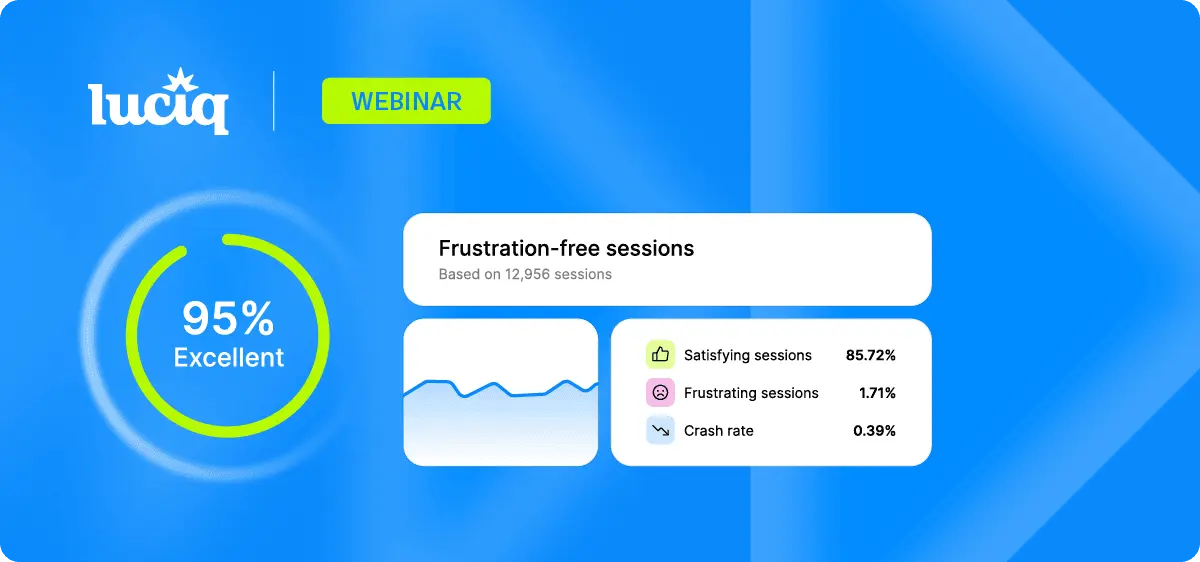
In What's New: Raising the Bar for Mobile Observability, we walk through how agentic mobile app observability reduces triage load, compresses MTTR, and surfaces silent UX failures before they become churn.
If release confidence still feels fragile despite green dashboards, this session shows what workflow-native observability actually looks like in practice.
Watch the full webinar to see the shift in action.