











Mobile observability tools that rely on on-device session capture make a compelling promise: logs captured directly on the device, no data sent to the cloud until you need it, no blind spots.
But there's a critical distinction that gets lost in that framing, capturing data and retaining data are two very different things. And for mobile teams trying to protect revenue at peak traffic, that difference is everything.
Mobile Observability Data Loss: The On-Device Buffer Problem
On-device session capture tools like Bitdrift store logs in a local buffer on the user's device. When that buffer fills up, older data gets overwritten. Permanently. No recovery, no replay, no post-incident forensics.
This matters most during the moments you care about most: peak traffic events, major releases, high-stakes user flows. Those are exactly the conditions that generate the highest log volume. And high log volume is exactly what fills a buffer fastest.
So the sessions most likely to be lost are the ones from your biggest sporting event, your Black Friday push, your new feature launch. The ones tied to real revenue.
Luciq Defines Agentic Mobile Observability: Every Session in Full Detail
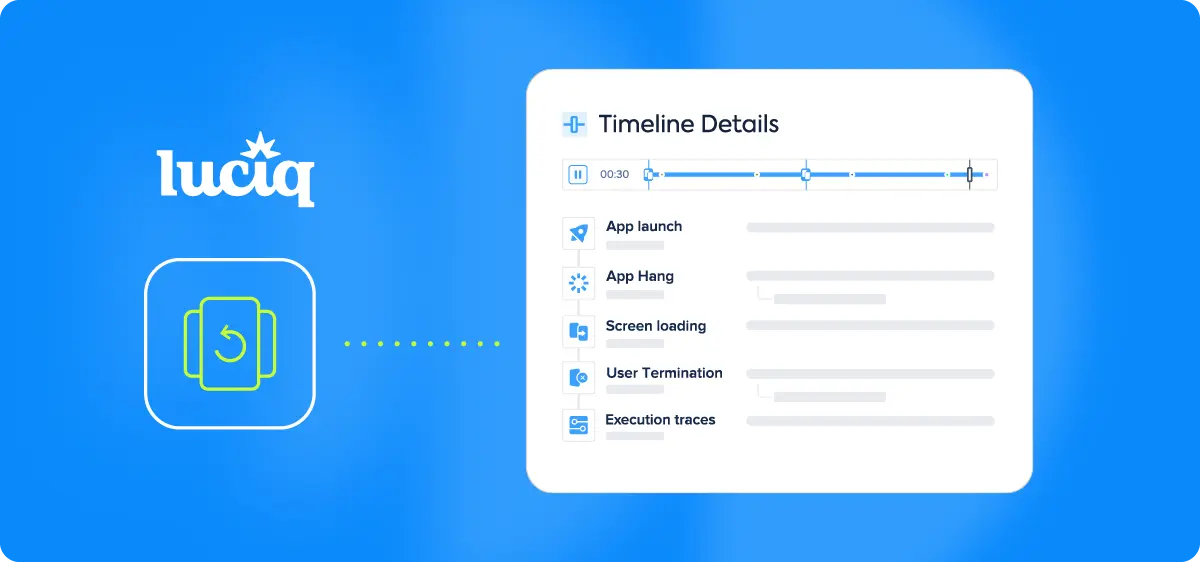
Luciq captures 100% of sessions with full logs and telemetry: no sampling, no overwriting, no data loss. Every session is stored with complete detail: network requests, user steps, screen rendering, crash context, and AI-generated reproduction steps. Not a representative sample. Not the ones that survived the buffer. All of them.
This isn't just a storage question. It's an architectural one. Bitdrift is a utility for managing logs. Luciq is business insurance. When data can be overwritten, your observability model is inherently reactive: you can only investigate what happened to survive. When every session is retained, agentic mobile observability becomes possible: surface issues before users report them, correlate patterns across the full population, and triage with confidence.
Luciq's Agentic Mobile Observability Catches What Reactive Tools Always Miss
On-device approaches require you to already know where to look. If you suspect a problem, you can fetch the relevant logs. But if you don't know something is broken (which is when you're most vulnerable) there's nothing to trigger that fetch.
Luciq's agentic mobile observability inverts this model entirely:
- The Detect Agent continuously monitors session data across your entire user base, surfacing visual issues and broken functionality before they generate crash reports or App Store reviews.
- The Resolve Agent provides AI-generated root cause analysis and fix suggestions.
- The Release Agent monitors new version health automatically from the moment a build goes live.
Luciq vs Bitdrift: Why Zero-Config Agentic Mobile Observability Costs Less
While Bitdrift may appear budget-friendly on a line item, it imposes a significant manual tax on your engineering team. Basic metrics like app launch times, screen loading, and network monitoring are not automatic; they require manual API calls and custom instrumentation.
Luciq uses a zero-config, auto-capture approach. Developer time is your most expensive resource. By automatically compiling the full story of a session, including network payloads and screen transitions, Luciq returns hundreds of hours to your team that would otherwise be spent manually tagging events.
Agentic Mobile Observability Gives You the "Why", Not Just the "What"
Bitdrift provides the "what", i.e. the logs. Luciq's agentic mobile observability provides the "why." When a crash occurs, a log tells you where the code failed, but it doesn't tell you how the user got there. Luciq provides high-fidelity session replays, OOM detection, and Flame Graphs for ANRs.
More importantly, Luciq bridges the resolution gap. AI-generated reproduction steps and visual context mean engineers achieve a first-try fix instead of guessing from a dry stack trace. If a user hits a silent checkout failure that doesn't trigger a crash, Bitdrift is blind. Luciq's Detect Agent sees the broken UI flow and alerts you before the first support ticket is filed.
Agentic Mobile Observability vs Keyhole Monitoring: A Full Platform Comparison
Bitdrift's sampling and on-demand fetching give you a keyhole view: you can only see what you already suspected was broken. Luciq's agentic mobile observability offers a wide-angle lens across your entire user base.
Agentic Mobile Observability in Practice: How Dabble Protected $1M in Peak Revenue
Dabble, a leading iGaming platform, was previously blind to 90% of user sessions during their highest-revenue events. After moving to Luciq's full-session agentic mobile observability, they reduced MTTR by 50–60%, reclaimed 20+ engineering hours per week, and protected over $1M in peak-event revenue, revenue that would have been invisible under a sampling or on-device buffer model.
Agentic Mobile Observability vs. On-Device Capture: The Defining Question
Don't ask "do you capture every session?" - most will say yes.
Ask: "Can a session ever be lost or overwritten after it's been captured?"
If the answer involves buffers, on-device storage limits, or on-demand fetching, you have your answer. With Luciq, the answer is no. Every session. Full detail. Always available.
👉 Book a demo to see what agentic mobile observability looks like in practice.