











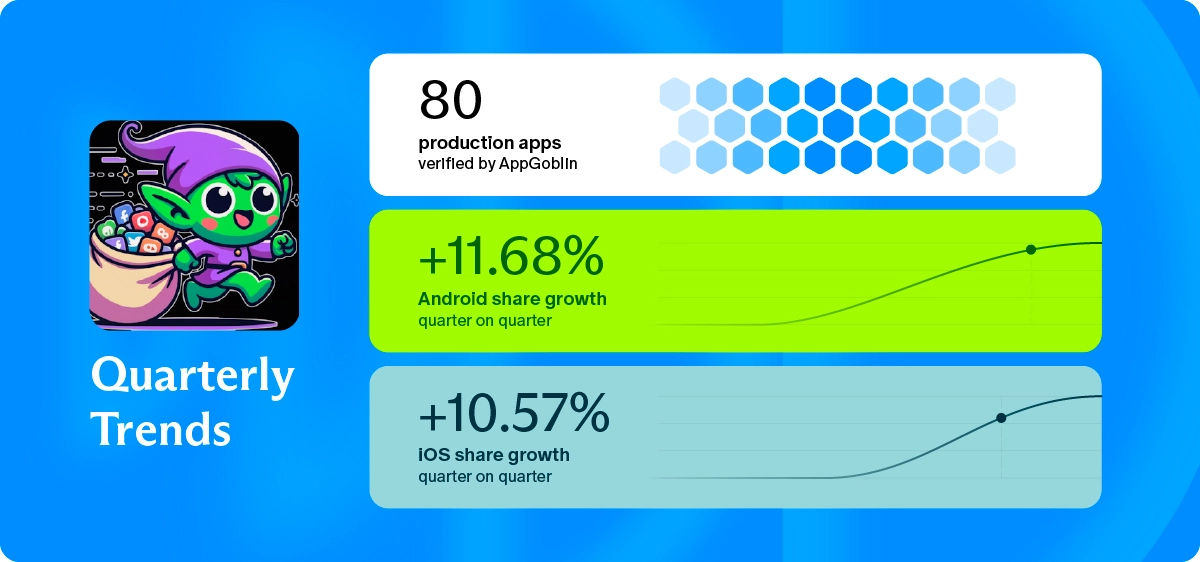
TL;DR: Mobile observability leader Luciq has been confirmed across 80 production apps by AppGoblin, an independent mobile SDK intelligence platform, through static decompilation: 34 on Android, 46 on iOS. SDK market share grew over 10% on both platforms, independently verified. Apps in the network include Instacart, Pinterest, T-Mobile, Southwest Airlines, and Adobe Photoshop. Luciq is the first and leading Agentic Mobile Observability platform, and this is what third-party market validation looks like in 2026.
Mobile observability should tell your engineers what broke before they ask. Right now, your best engineers are not slow. They are stuck. Stuck reproducing bugs that should never require manual reproduction. Stuck triaging incidents that an agent could have routed before anyone opened a Slack thread. Stuck in a maintenance loop that compounds every time the team ships faster, because the signal layer underneath the deployment layer has not kept pace.
AppGoblin, an independent mobile SDK intelligence platform, published Luciq's company profile. It maps Luciq's SDK across 80 production apps: 34 on Android, 46 on iOS, confirmed through static decompilation of the actual app binaries. The list includes Instacart at 2.6M monthly iOS installs, Pinterest at 2.1M, T-Mobile's T-Life at 1.7M, plus Southwest Airlines and Adobe Photoshop.
SDK market share is up 11.68% on Android and 10.57% on iOS per AppGoblin's independent analysis. These are the engineering organizations that decided the current way of running mobile was no longer acceptable.
What Mobile SDK Intelligence Actually Measures
Mobile SDK intelligence is the practice of tracking which software libraries are embedded in production apps, mapping those integrations to real install volumes and market share trends, and publishing the findings independently of the vendors themselves.
AppGoblin does this through static decompilation: it unpacks app binaries, reads the embedded SDK signatures, and cross-references the findings against app store install data. The result is a market-wide view of which platforms scaled engineering organizations are actually running in production, verified against real install volumes, not vendor claims.
What the Luciq profile shows: 80 apps, over 10% growth on both platforms, and category leaders across grocery, social, telecommunications, creative tools, and travel all running it at scale.
What Makes Mobile Observability Different from General APM
Mobile application performance monitoring - built for backend infrastructure - cannot capture what happens on the device. Mobile observability is a different discipline from general APM because the failure surface is structurally different.
Generic APM tools measure server latency, database queries, and API response times. When a mobile app breaks, they surface which API call failed. They do not show you what the user was doing before it failed, what device state preceded it, or whether the failure generated an exception at all. Battery pressure, OS fragmentation across thousands of device variants, background process termination, and network switching are mobile-native failure modes that backend APM tools were not built to detect.
A UI hang at 700 milliseconds does not throw an exception. An ANR does not appear in your server logs. A gesture that silently fails inside a checkout flow generates no error, but it does generate frustration, a negative review, and an uninstall. Luciq's own research found that 83.4% of users rate stability as a top priority, and 15.4% will uninstall after a single crash, before your team has even opened a ticket.
Standard crash reporting counts the outcomes that produced a signal. It ignores everything that did not, and it hands the investigation to the engineer who least deserves to spend their morning on it.
The Innovation Tax: Why Faster Shipping Makes the Maintenance Problem Worse
There is a dynamic worth naming here, because it is what separates the engineering organizations in the AppGoblin network from teams still treating observability as a reactive tool.
AI coding agents have made mobile teams faster. They have also made the maintenance problem harder. When you ship more surface area faster, the number of things that can fail in production grows proportionally. The signal layer has not kept pace with the deployment layer, and no amount of faster shipping closes that gap on its own. As Luciq CEO Jim Douglas argued in Forbes, what engineering organizations actually need is not more monitoring but intelligence embedded into the operating model itself, the kind that detects, resolves, and prevents before a single user is affected.
According to DevOps.com, 40% of developers still lose a quarter of their work week to bug fixes and maintenance. That is the innovation tax: the compounding engineering cost that accumulates when the observability layer stops at the alert and hands the rest to engineers manually. The teams that have closed that gap are not just monitoring more signals. They are using observability data as a forward-looking product input, connecting behavioral signals and technical session context to actual business outcomes before issues compound into churn.
What the Best APM Tool for Mobile Teams Actually Does in 2026
Luciq goes past the alert in four directions. The Detect Agent surfaces visual regressions and logic failures that produce no exception and no crash report. The Resolve Agent runs root cause analysis across every occurrence of an issue and drafts a pull request so the engineer reviews a fix, not a stack trace. The Release Agent monitors performance per feature flag and halts a faulty rollout before the blast radius grows. And the intelligence layer connects issue severity to business impact scoring, so engineering prioritization is ranked by estimated revenue and retention risk, not ticket age.
That last part is where the category is heading and where no competitor has yet gone. Every other platform in the market is building around the question "what broke?" The question engineering executives are actually asking in 2026 is what should we build next, and what is the cost of not fixing this first. The organizations capturing AI value are not the ones with the most tools, they are the ones treating workflow redesign as a leadership priority, with owners, timelines, and accountability.
Why Scaled Mobile Engineering Teams in the AppGoblin Network Chose Luciq
The apps in the AppGoblin listing are not experimental integrations. They are production apps serving millions of users in categories where a frustrating session has a direct and measurable cost.
Dabble, the iGaming platform, cut MTTR by 50 to 60% and protected over $1M in peak-event revenue after moving to Luciq. Before Luciq, their engineers could not connect network performance, ANR events, and user session context into a single view. Every incident required manual reconstruction of what happened, across tools that were never designed to talk to each other. With Luciq, their team shifted from reactive firefighting to shipping with confidence through peak season, with the signal layer doing the work that used to consume their sprints.
Southwest Airlines, Adobe Photoshop, Pinterest, and T-Mobile's T-Life are running Luciq in that same environment: production scale, high-stakes categories, millions of users, and no margin for a maintenance loop that compounds.
Mobile Observability Data Architecture: Why Signal Quality Determines Agent Performance
The AppGoblin profile reflects 80 apps running Luciq's SDK, and the growth rate confirms the trajectory. What those 80 apps have in common is that they chose a platform built on a specific premise: the data quality underneath the observability layer determines what is actually possible on top of it.
Luciq organizes mobile signals into structured, high-fidelity context: device state, user interaction sequences, network transitions, session-level behavioral patterns, and release history, unified so that an AI agent can reason over them without reconstructing the picture from raw logs. Luciq's MCP Server delivers that context directly into the AI development tools mobile engineers already use. MCP is the open standard introduced by Anthropic that allows AI-powered IDEs like Cursor and Claude Code to query Luciq's crash data, session context, and release analytics from inside the coding environment. No context switching, no manual reproduction, no breaking flow state to go find the data that should already be where the code gets written.
The MCP integration converts mobile observability data into agent-ready context: the signal quality and structure that lets an AI agent reason about a production issue the way a senior mobile developer would, without the four hours of archaeology that senior developer would otherwise spend getting there.
What the AppGoblin Data Confirms About the Mobile Observability Market
When engineering organizations at the scale of Instacart, Pinterest, T-Mobile, Southwest Airlines, and Adobe independently arrive at the same platform decision, the pattern is worth understanding. The adoption trend AppGoblin is tracking is not a marketing claim. It is the aggregate output of engineering decisions made at organizations where the cost of a wrong platform choice is measured in sprint capacity, retention metrics, and release confidence.
The category AppGoblin uses is Business Tools, which reflects how the market actually deploys Luciq: as a core infrastructure layer running the full mobile maintenance lifecycle, not a crash monitoring add-on that alerts and waits.
For engineering executives weighing the innovation tax against the cost of another reactive quarter, and for mobile engineers who are tired of being the routing middlemen between a crash report and a fix, that distinction is the whole argument.